Terms of Relationship
Gross Anatomy · Foundations
Introduction
Introduction to Anatomical Terms of Relationship
In medicine and anatomy, standard language is vital to eliminate ambiguity. Terms of relationship describe the position of one body structure relative to another, always assuming the body is in the standard anatomical position—standing erect, facing forward, arms at the sides, palms facing forward, and feet flat on the floor. Without these universal reference points, clinical communication regarding diagnostic imaging, surgical approaches, and physical examinations would be prone to catastrophic errors.
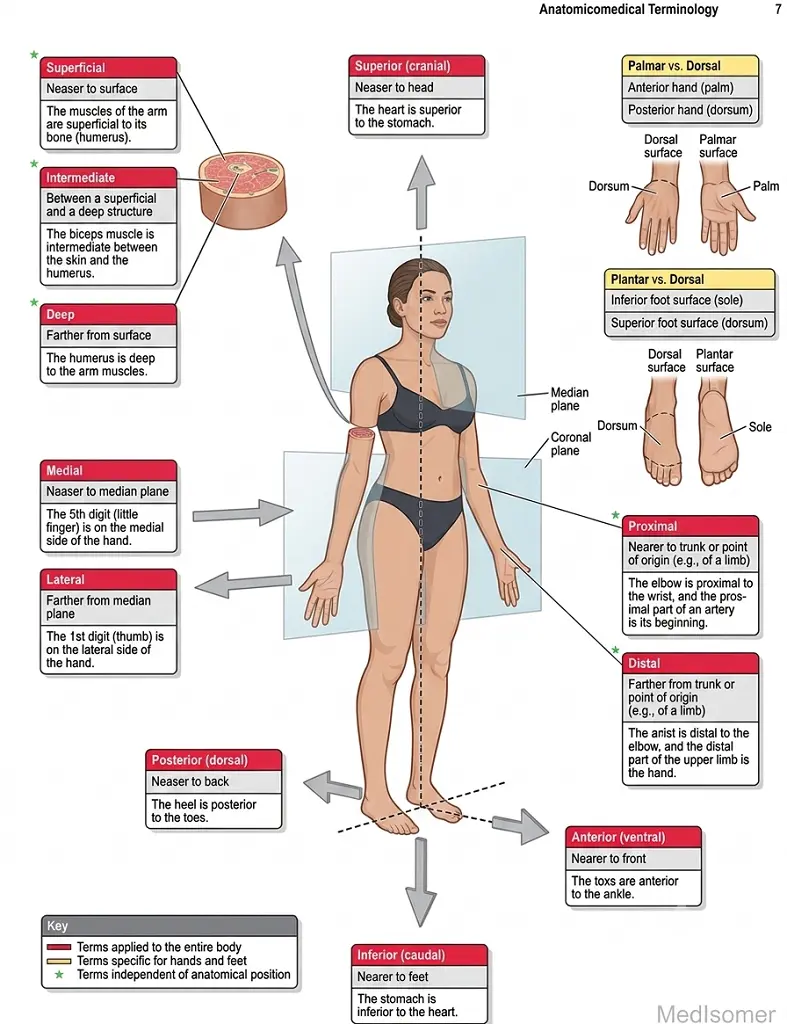
Study
Primary Axes and Direct Relationships
Anatomical relationships are grouped into opposing pairs along three spatial dimensions: 1. Superior (Cranial/Cephalic) vs. Inferior (Caudal): • Superior structures are positioned closer to the head or upper part of a structure (e.g., the eyes are superior to the mouth). • Inferior structures are positioned closer to the feet or lower part of the body (e.g., the stomach is inferior to the lungs). In embryology and comparative anatomy, cranial and caudal are preferred. 2. Anterior (Ventral) vs. Posterior (Dorsal): • Anterior describes structures toward the front of the body (e.g., the sternum is anterior to the heart). • Posterior describes structures toward the back of the body (e.g., the vertebrae are posterior to the aorta). 3. Medial vs. Lateral: • Medial indicates a position closer to the vertical midline of the body (e.g., the nose is medial to the eyes). • Lateral indicates a position further away from the midline, toward the sides (e.g., the ears are lateral to the cheeks).
Limb-Specific and Positional Relationships
When describing structures relative to limbs, specific terms provide greater accuracy: • Proximal vs. Distal: Proximal means closer to the point of attachment to the trunk or origin of a functional system (e.g., the shoulder is proximal to the elbow). Distal means further from the attachment point or origin (e.g., the wrist is distal to the elbow). • Superficial vs. Deep: Superficial indicates a position closer to the external surface of the body (e.g., the epidermis is superficial to the dermis). Deep indicates a position further internal, away from the surface (e.g., the femur is deep to the quadriceps muscle). • Ipsilateral vs. Contralateral: Ipsilateral refers to structures on the same side of the body (e.g., the right hand and right foot). Contralateral refers to structures on opposite sides of the body (e.g., a stroke affecting the left motor cortex causes contralateral paralysis in the right arm).
Summary
Summary of Relationship Terms
Mastering directional terms ensures flawless anatomical documentation. Remember that clinical descriptions always relate to the patient's perspective of left and right, not the examiner's. Key relationships to lock down: Superior/Inferior (vertical axis), Anterior/Posterior (front/back axis), Medial/Lateral (midline reference), Proximal/Distal (appendicular distance from trunk), and Superficial/Deep (depth axis). These foundational coordinates form the bedrock of surgical planning and radiological interpretation.