Terms of Comparison
Gross Anatomy · Foundations
Introduction
Introduction to Anatomical Terms of Comparison
In medical practice, human anatomy cannot be described purely in isolation. To communicate clinical findings, interpret diagnostic imaging, and perform surgical procedures accurately, practitioners must rely on Terms of Comparison. Unlike absolute directional terms, comparative terms describe the relative position, depth, or alignment of anatomical structures relative to one another or to the surface of the body. Mastering these terms prevents critical errors in surgical localization, physical examination documentation, and radiological assessment.
Study
Deep Dive into Comparative Anatomical Relationships
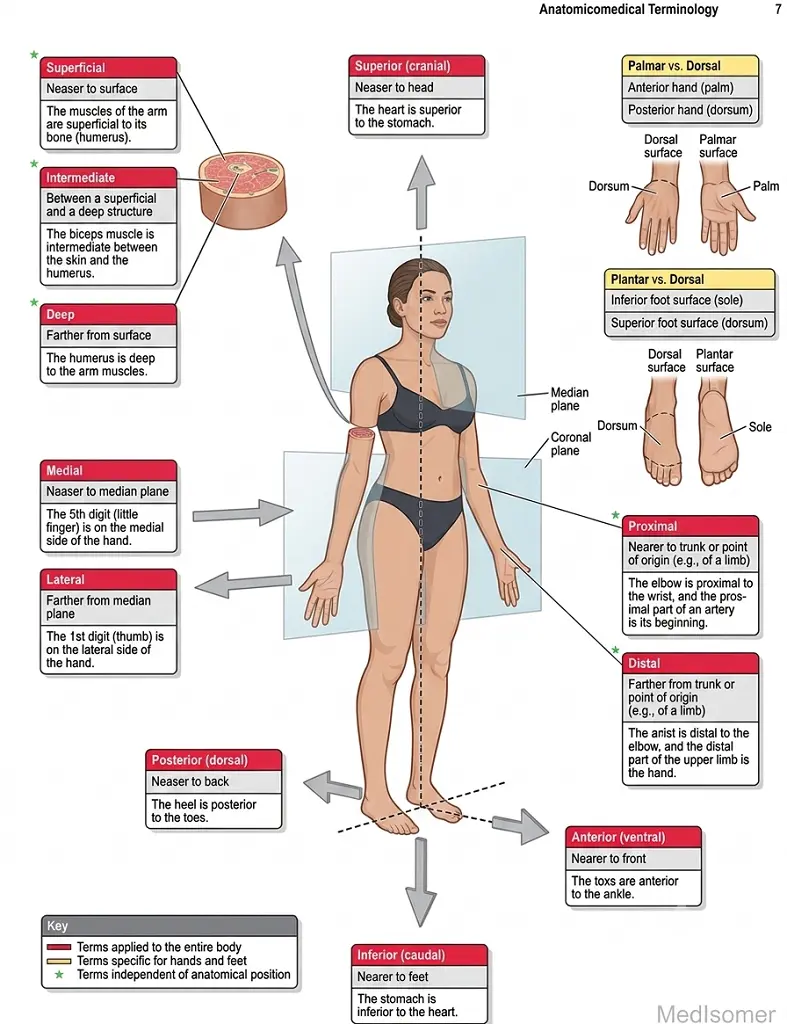
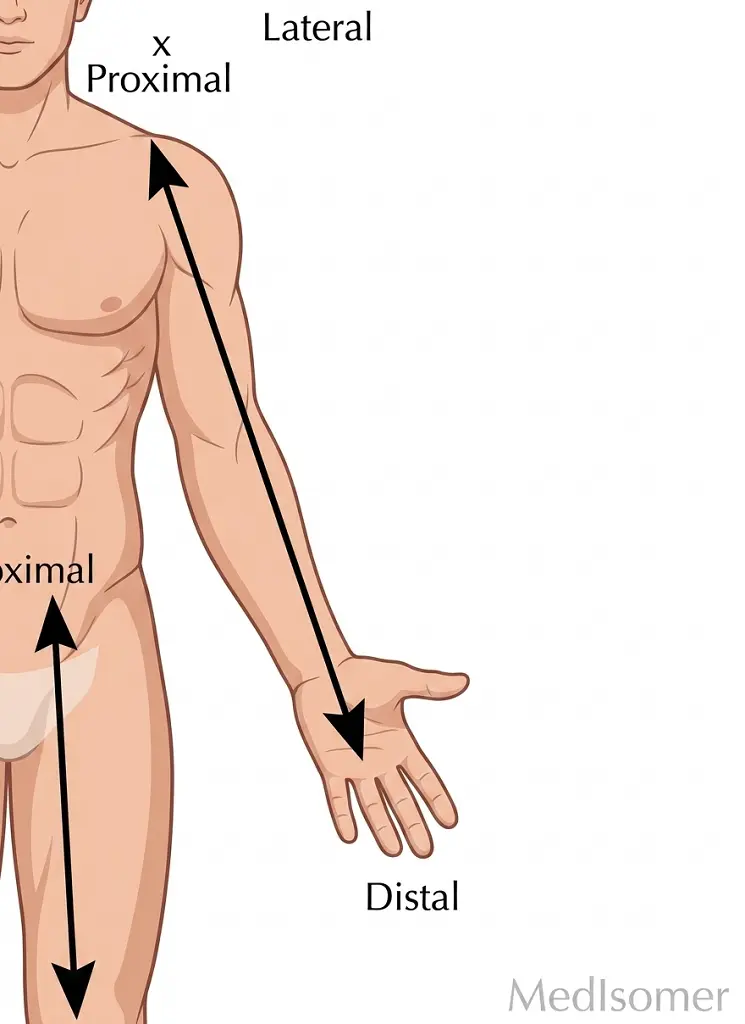
Anatomical comparison can be systematically categorized into three main structural relationships: depth, proximity to the trunk, and midline positioning. 1. Depth Relationships (Superficial vs. Intermediate vs. Deep): - Superficial (External): Denotes a structure closer to the skin surface. For example, the skin is superficial to the rectus abdominis muscle. - Intermediate: Positioned between a superficial and a deep structure. The rectus abdominis muscle is intermediate between the abdominal skin and the parietal peritoneum. - Deep (Internal): Denotes a structure located further away from the surface, toward the core of the body or body cavity. The abdominal aorta is deep to the small intestines. 2. Extremity Proximity (Proximal vs. Distal): These terms are strictly used when describing positions relative to the point of attachment of a limb (extremity) to the trunk or origin of a structure. - Proximal: Closer to the trunk or point of origin. The shoulder is proximal to the elbow; the femur is proximal to the tibia. - Distal: Farther from the trunk or point of origin. The phalanges are distal to the metacarpals. 3. Midline Context (Medial vs. Lateral vs. Ipsilateral vs. Contralateral): - Medial: Structure closer to the median sagittal plane. The ulna is medial to the radius in the anatomical position. - Lateral: Structure further away from the median plane. The thumb (pollex) is lateral to the pinky finger (digiti minimi). - Ipsilateral: Refers to structures occurring on the same side of the body. The right arm and right leg are ipsilateral to each other. A lesion in the right cerebellar hemisphere causes ipsilateral deficits. - Contralateral: Refers to structures on opposite sides of the body. The left motor cortex controls the contralateral (right) hand musculature.
Summary
Summary of Key Terms
Terms of comparison are relativistic markers crucial for accurate medical documentation and clinical intervention. Remember: - Superficial/Deep describe multi-layered tissues relative to the skin surface. - Proximal/Distal are reserved for linear structures, primarily limbs, tracking proximity to the attachment point. - Ipsilateral and Contralateral streamline clinical neurological and musculoskeletal assessments by defining same-side versus opposite-side relationships.