Movements of Joints
Gross Anatomy · Foundations
Introduction
Introduction to Movements of Joints
Kinesiology and arthrology form the foundational language of musculoskeletal anatomy. Movement at a joint occurs when skeletal muscles contract, pulling their insertions toward their origins across a joint space. These movements are categorized based on the specific anatomical planes (sagittal, frontal, and transverse) and axes around which they take place. Understanding these directional modifications of the body is essential for clinical examination, structural analysis, and localized injury assessment.
Study
Anatomical Planes and Associated Axes
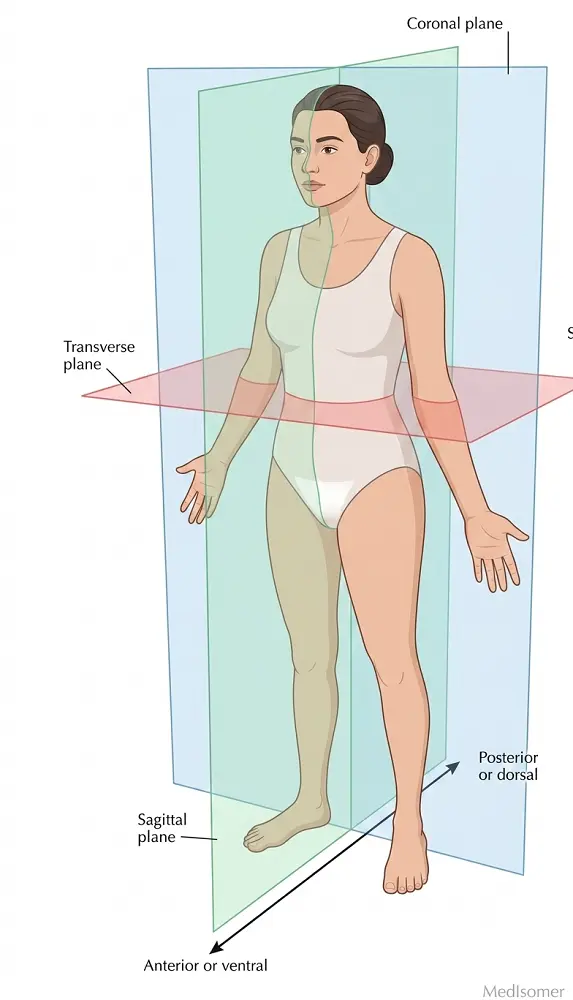
All voluntary joint movements take place within a specific plane and around a perpendicular axis. 1. Sagittal Plane: Divides the body into left and right halves. Movements within this plane occur around a transverse (coronal) axis. 2. Frontal (Coronal) Plane: Divides the body into anterior and posterior portions. Movements within this plane occur around an anteroposterior (sagittal) axis. 3. Transverse (Axial) Plane: Divides the body into superior and inferior portions. Movements occur around a vertical (longitudinal) axis.
Sagittal Plane Movements: Flexion and Extension
Flexion decreases the angle between articulating bones, typically moving a body part anteriorly (with the notable exception of the knee, where flexion moves the leg posteriorly). Extension increases the angle between articulating elements, typically returning the body part to the standard anatomical position. Hyperextension refers to extension beyond the normal anatomical limit or past 180 degrees. At the ankle joint, unique terms are applied: Dorsiflexion lifts the dorsum of the foot superiorly toward the shin, while Plantarflexion depresses the foot downward, elevating the heel.
Frontal Plane Movements: Abduction, Adduction, Lateral Flexion, Inversion, and Eversion
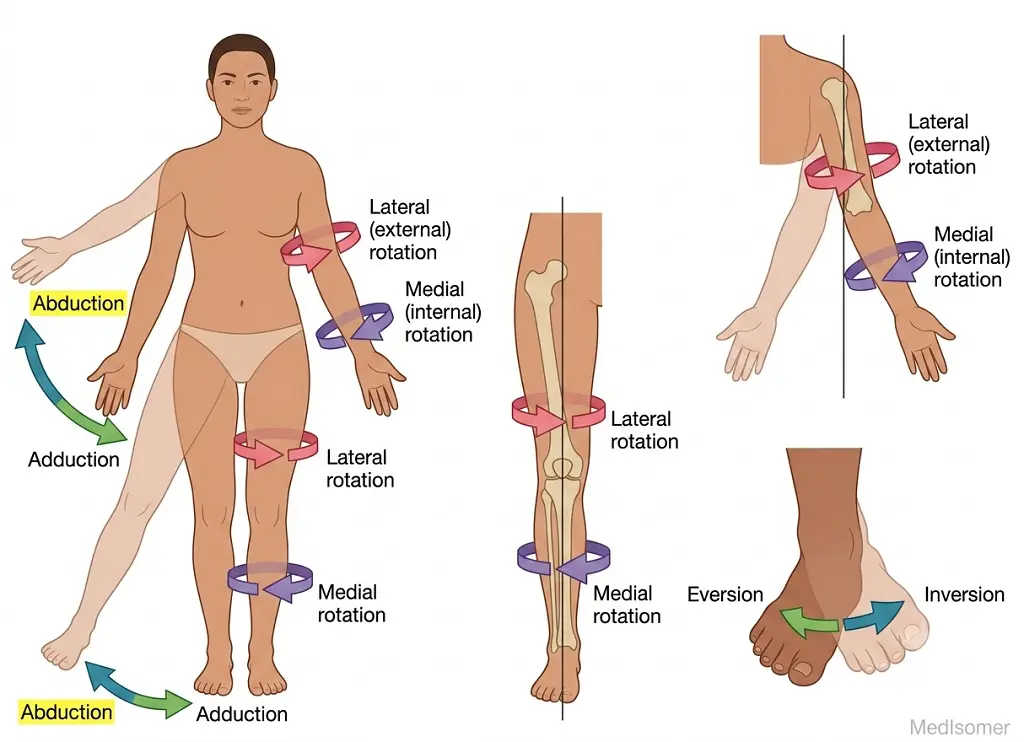
Abduction moves a limb laterally away from the midline of the body. For fingers and toes, the reference midline shifts to the third digit (middle finger) and second digit (second toe), respectively. Adduction moves a limb medially toward the midline or adjacent digits. Lateral flexion describes the lateral bending of the vertebral column (head or trunk) to the left or right side. Inversion turns the sole of the foot inward toward the midline, whereas Eversion turns the sole outward, away from the midline.
Transverse Plane Movements: Rotation, Pronation, and Supination
Rotation involves turning a bone around its long longitudinal axis. Medial (internal) rotation turns the anterior surface toward the midline, while Lateral (external) rotation turns it away from the midline. In the forearm, specialized rotational actions occur at the radioulnar joints: Supination rotates the radius laterally so that the palm faces anteriorly (or superiorly if the elbow is flexed), positioning the radius and ulna parallel. Pronation rotates the radius medially across the ulna, crossing them in an 'X' shape, causing the palm to face posteriorly.
Specialized Complex Movements
Circumduction is a sequential combination of flexion, abduction, extension, and adduction occurring in a continuous loop, drawing a cone shape in space; it is highly characteristic of ball-and-socket joints like the shoulder and hip. Elevation moves a structure superiorly (e.g., shrugging shoulders), while Depression moves it inferiorly. Protraction (protrusion) shifts a body part anteriorly in a horizontal plane (e.g., jutting out the jaw), whereas Retraction (retrusion) shifts it posteriorly back to anatomical position. Opposition is the unique movement of the thumb pad toward the pad of another digit, facilitated by the saddle joint at the first carpometacarpal level.
Summary
Summary of Joint Movements
Joint movements are highly coordinated geometric adaptations. Angular variations like flexion and extension alter bone angles within the sagittal plane, while abduction and adduction alter relationships within the frontal plane. Rotational dynamics (including pronation/supination) manipulate positioning across the transverse plane around a vertical axis. Specialized terms are strictly isolated to discrete anatomical regions: inversion/eversion at the subtalar foot complexes, dorsiflexion/plantarflexion at the talocrural joint, and opposition at the thumb.