Clavicle
Gross Anatomy · Osteology
Introduction
Introduction to the Clavicle
The clavicle, commonly known as the collarbone, is a long bone situated horizontally at the root of the neck. It forms the anterior component of the shoulder girdle and acts as a strut that holds the upper limb away from the trunk, allowing free movement of the shoulder. The clavicle connects the upper limb to the axial skeleton through its articulation with the sternum.
The clavicle is unique among long bones because it lies horizontally, lacks a medullary cavity, is subcutaneous throughout its length, and is the first bone in the body to begin ossification.
Study
Classification and Functions
The clavicle is classified as a long bone despite lacking a medullary cavity. It serves several important functions: transmitting forces from the upper limb to the axial skeleton, acting as a strut to keep the shoulder away from the thorax, protecting neurovascular structures passing from the neck to the upper limb, and providing attachment sites for numerous muscles and ligaments.
Side Determination
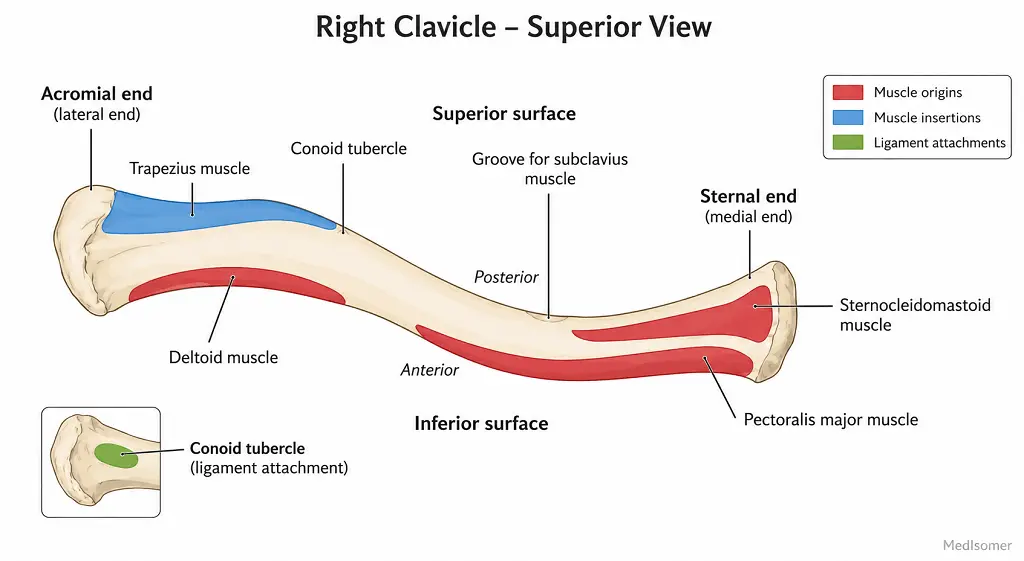
To identify the side of a clavicle, the bulky quadrangular sternal end is placed medially, the flattened acromial end laterally, the smooth surface superiorly, and the conoid tubercle inferolaterally. The medial two-thirds of the shaft is convex anteriorly, while the lateral one-third is concave anteriorly.
Parts of the Clavicle
The clavicle consists of a medial (sternal) end, a lateral (acromial) end, and a shaft. The shaft is divided into a medial two-thirds and a lateral one-third, each possessing distinct anatomical features and muscle attachments.
Sternal End
The sternal end is large, quadrangular, and articulates with the clavicular notch of the manubrium sterni and the first costal cartilage to form the sternoclavicular joint. This is the only bony connection between the upper limb and the axial skeleton.
Acromial End
The acromial end is flattened and articulates with the acromion process of the scapula to form the acromioclavicular joint.
Shaft of the Clavicle
The medial two-thirds of the shaft is rounded and convex anteriorly. The lateral one-third is flattened and concave anteriorly. These curvatures increase strength and help absorb transmitted forces.
Muscle Attachments
The clavicle provides attachment for several muscles. The sternocleidomastoid attaches to the superior surface of the medial third. The pectoralis major arises from the anterior surface of the medial half. The deltoid originates from the anterior border of the lateral third. The trapezius inserts on the posterior border of the lateral third. The subclavius muscle attaches to the subclavian groove on the inferior surface.
Ligament Attachments
The costoclavicular ligament attaches to the costal tuberosity or impression for the costoclavicular ligament on the inferior surface near the sternal end. The coracoclavicular ligament attaches laterally and consists of the conoid ligament attached to the conoid tubercle and the trapezoid ligament attached to the trapezoid line.
Ossification
The clavicle is the first bone in the body to begin ossification, starting around the fifth to sixth week of intrauterine life. It ossifies primarily by intramembranous ossification, although the sternal end develops through endochondral ossification. The secondary ossification center appears at the sternal end and is the last epiphysis in the body to fuse, usually around 25 years of age.
Applied Anatomy
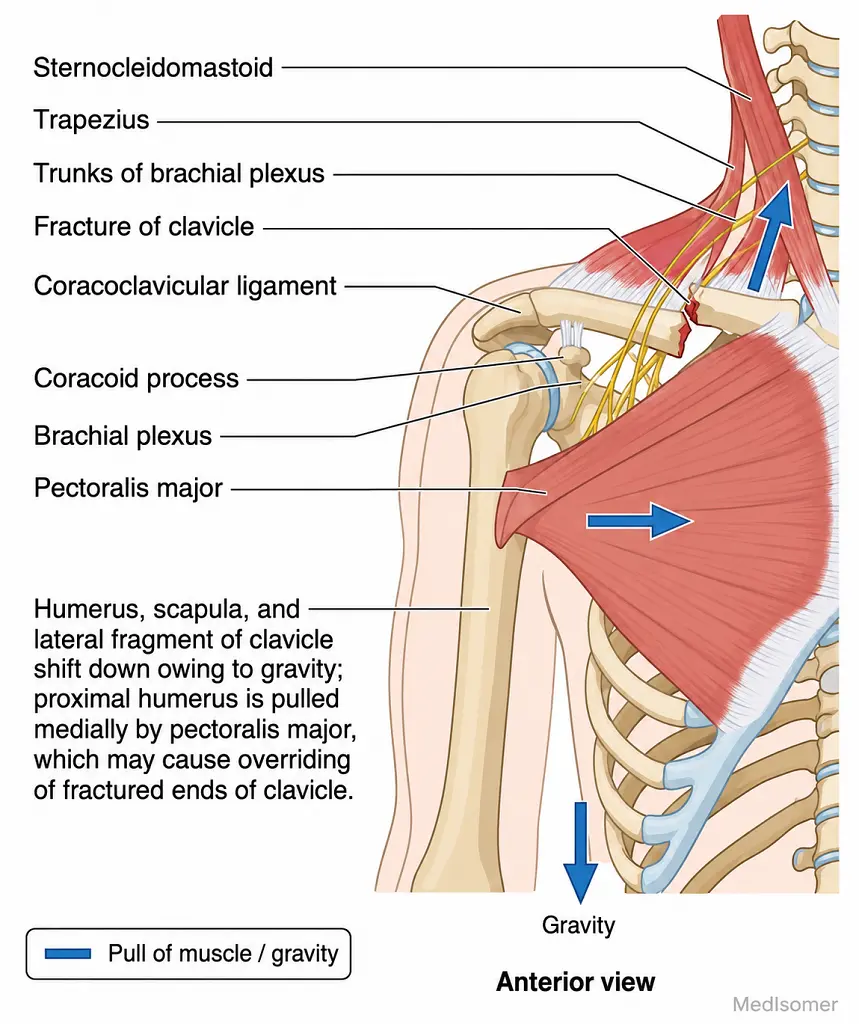
The clavicle is one of the most commonly fractured bones in the body, particularly at the junction of the medial two-thirds and lateral one-third. Following fracture, the medial fragment is elevated by the sternocleidomastoid muscle, while the lateral fragment is displaced downward by the weight of the limb. Fractures may endanger underlying neurovascular structures such as the subclavian vessels and brachial plexus.
Summary
Summary
The clavicle is a horizontally placed long bone that forms the anterior component of the pectoral girdle. It connects the upper limb to the axial skeleton through the sternoclavicular joint and articulates laterally with the acromion. The bone consists of a sternal end, acromial end, and shaft. It serves as a strut, protects neurovascular structures, and provides numerous muscular and ligamentous attachments. The clavicle is unique because it is the first bone to ossify and ossifies mainly through intramembranous ossification. Clinically, it is one of the most frequently fractured bones.