Attachment of Muscles
Gross Anatomy · Foundations
Introduction
Introduction to Muscle Attachments
In human anatomy, muscles do not act in isolation. To generate movement, stabilize joints, and maintain posture, skeletal muscles must firmly anchor to the skeletal framework. Understanding how muscles attach to bones, cartilage, ligaments, or skin is fundamental to analyzing human biomechanics and functional anatomy. Traditionally, these attachments have been classified as 'origins' and 'insertions,' concepts rooted in which bone remains relatively stationary and which one moves during concentric contraction.
Study
1. Concepts of Origin and Insertion
Skeletal muscles bridge at least one joint between their fixed and mobile ends. The Origin is typically defined as the proximal, less mobile or fixed attachment point during standard movement. The Insertion is the distal, more mobile attachment point that is pulled toward the origin during a typical muscle contraction. However, these roles can reverse during closed-chain kinetic movements (e.g., during a pull-up, the distal insertion on the humerus becomes fixed, and the proximal body is pulled upward).
2. Types of Structural Attachments: Tendons vs. Aponeuroses
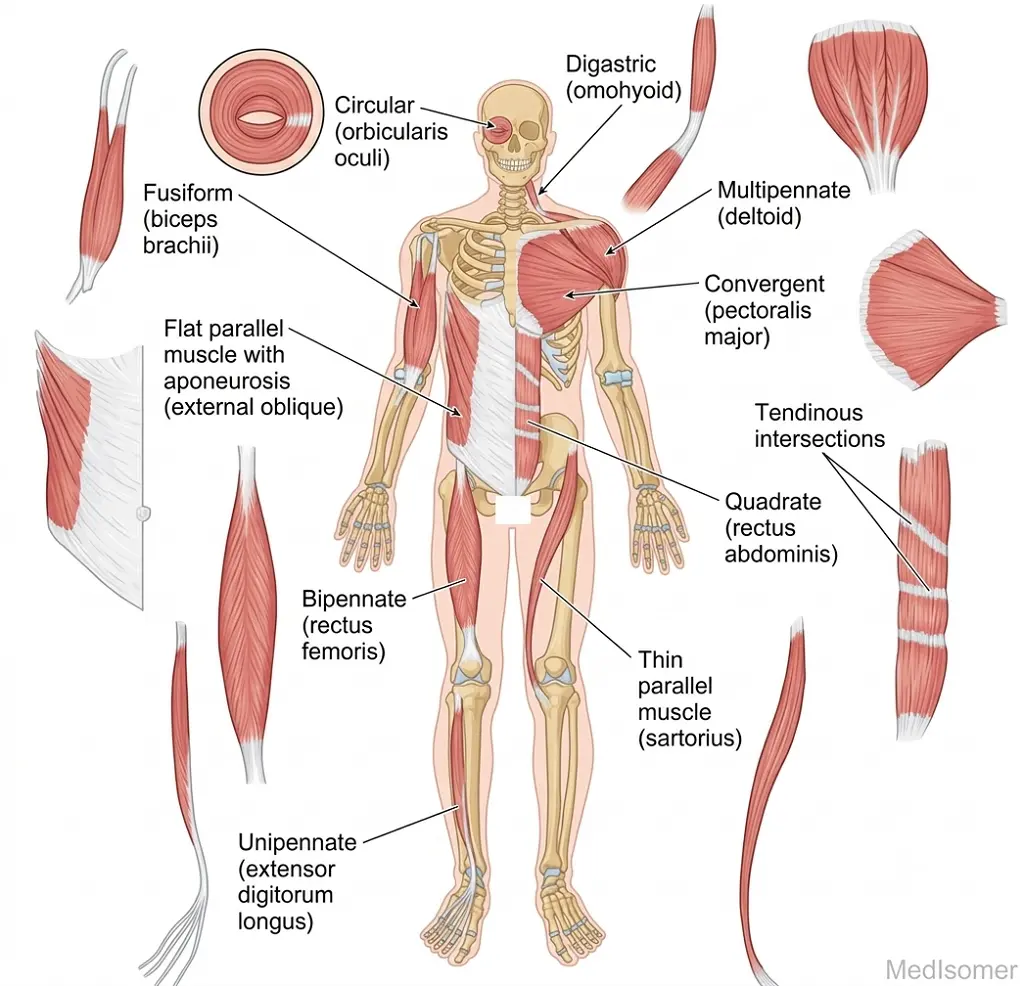
Muscles attach via specialized dense regular connective tissue structures. Tendons are tough, rounded, cord-like cords of fibrous tissue that concentrate muscle pull onto a small, localized area of bone (e.g., the Achilles tendon). Aponeuroses are broad, flat, sheet-like structures that distribute muscle forces across a wider surface area or anchor muscles to deep fascia or other muscles (e.g., the epicranial aponeurosis or the external oblique aponeurosis).
3. Direct (Fleshy) vs. Indirect Attachments
In direct (fleshy) attachments, the epimysium of the muscle fuses directly to the periosteum of a bone or the perichondrium of cartilage, making the muscle look as if it emerges straight out of the bone. In indirect attachments, the muscle's connective tissue wrappings extend beyond the contractile muscle fibers as a distinct tendon or aponeurosis to fuse with the bone's periosteum. Indirect attachments are much more common because they are durable, conserve space, and can comfortably cross over bony projections.
4. Specialized Attachments
Not all muscles anchor directly to bones. Some attach to specialized structural lines or networks. A Raphe is a structural seam or line of fibrous tissue where symmetrical halves of a muscle meet or interlace (e.g., the mylohyoid raphe or the pharyngeal raphe). Intermuscular Septa are deep fascial sheets that separate functional muscle compartments within a limb and offer extensive surface areas for muscular origin or insertion.
Summary
Summary of Muscle Attachments
Skeletal muscles possess functional attachment points known as origins (proximal/stable) and insertions (distal/mobile). Structurally, these attachments are either direct (fleshy) or indirect via tendons (cord-like) or aponeuroses (sheet-like). Specialized junctions include raphes and intermuscular septa, which play vital roles in distributing mechanical forces throughout the musculoskeletal system.