Anatomical Position
Gross Anatomy · Foundations
Introduction
Introduction to Anatomical Position
Anatomical position is the universally accepted reference posture used in anatomy to describe the location of structures and the relationship between different parts of the body. It provides a standard point of reference that allows healthcare professionals, anatomists, and students to communicate accurately without ambiguity.
Regardless of a person's actual posture during examination or daily activities, anatomical descriptions are always based on the anatomical position.
Study
Definition of Anatomical Position
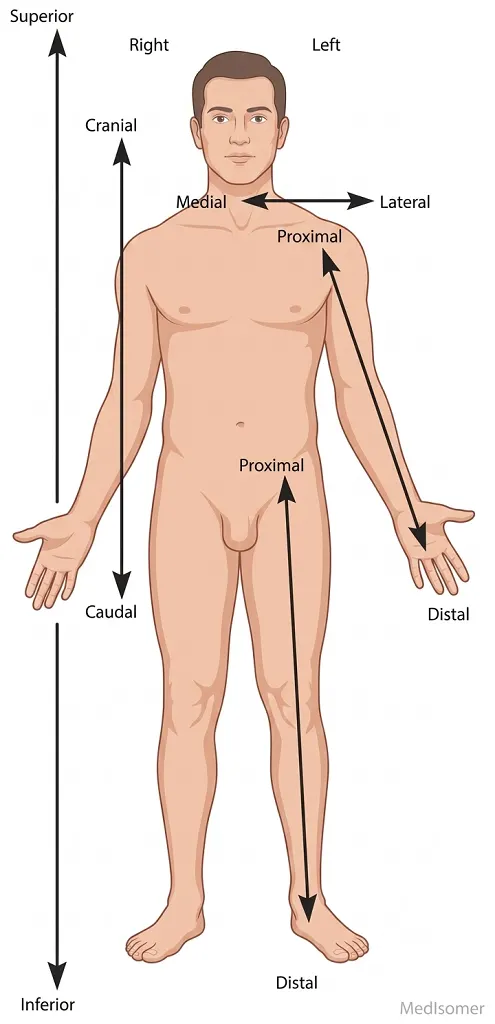
Anatomical position is a standardized body posture in which the individual stands erect, faces forward, keeps the head and eyes directed anteriorly, holds the upper limbs by the sides with palms facing forward, and keeps the lower limbs together with feet directed forward.
Features of Anatomical Position
The body is upright and erect. The head is level and the face is directed forward. The eyes look straight ahead. The upper limbs hang by the sides of the trunk. The forearms are supinated so that the palms face anteriorly. The fingers are extended and directed inferiorly. The lower limbs are together or slightly apart, and the feet point forward.
Importance of Anatomical Position
Anatomical position serves as the foundation for anatomical terminology. Terms such as superior, inferior, anterior, posterior, medial, lateral, proximal, distal, superficial, and deep are all defined relative to this position. Without a standard reference, descriptions of body structures would be inconsistent and confusing.
Clinical examination, medical imaging, surgery, and anatomical education all rely on anatomical position to ensure accurate communication.
Anatomical Position and Forearm Orientation
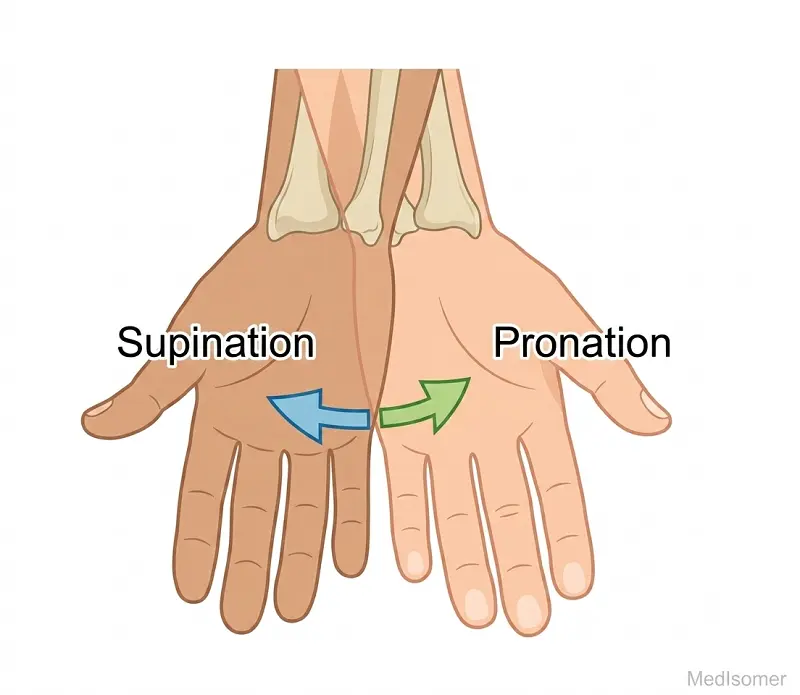
A distinctive feature of anatomical position is that the palms face anteriorly. This occurs because the forearm is supinated, causing the radius and ulna to lie parallel to each other. In pronation, the radius crosses over the ulna and the palms face posteriorly when standing.
Anatomical Position Versus Normal Standing Posture
Most individuals standing naturally have their palms facing medially toward the thighs. However, anatomical position requires the forearms to be supinated so that the palms face forward. This distinction is important because anatomical descriptions are always based on the standardized position rather than the individual's natural posture.
Clinical Relevance
When clinicians describe injuries, imaging findings, surgical approaches, or physical examination results, they do so relative to anatomical position. For example, the thumb is described as lateral to the little finger because this relationship exists in anatomical position.
Summary
Summary
Anatomical position is the standard reference posture used in anatomy. In this position, the body stands erect, faces forward, the upper limbs are at the sides, the palms face anteriorly, and the feet point forward. It provides a universal framework for describing body structures and relationships.
Understanding anatomical position is essential because all anatomical terminology, body planes, movements, and clinical descriptions are based upon it.